Rules that fail the build.
Every company says it cares about accuracy. What matters is whether anything stops the inaccurate thing from shipping.
A number must have been asked of the record
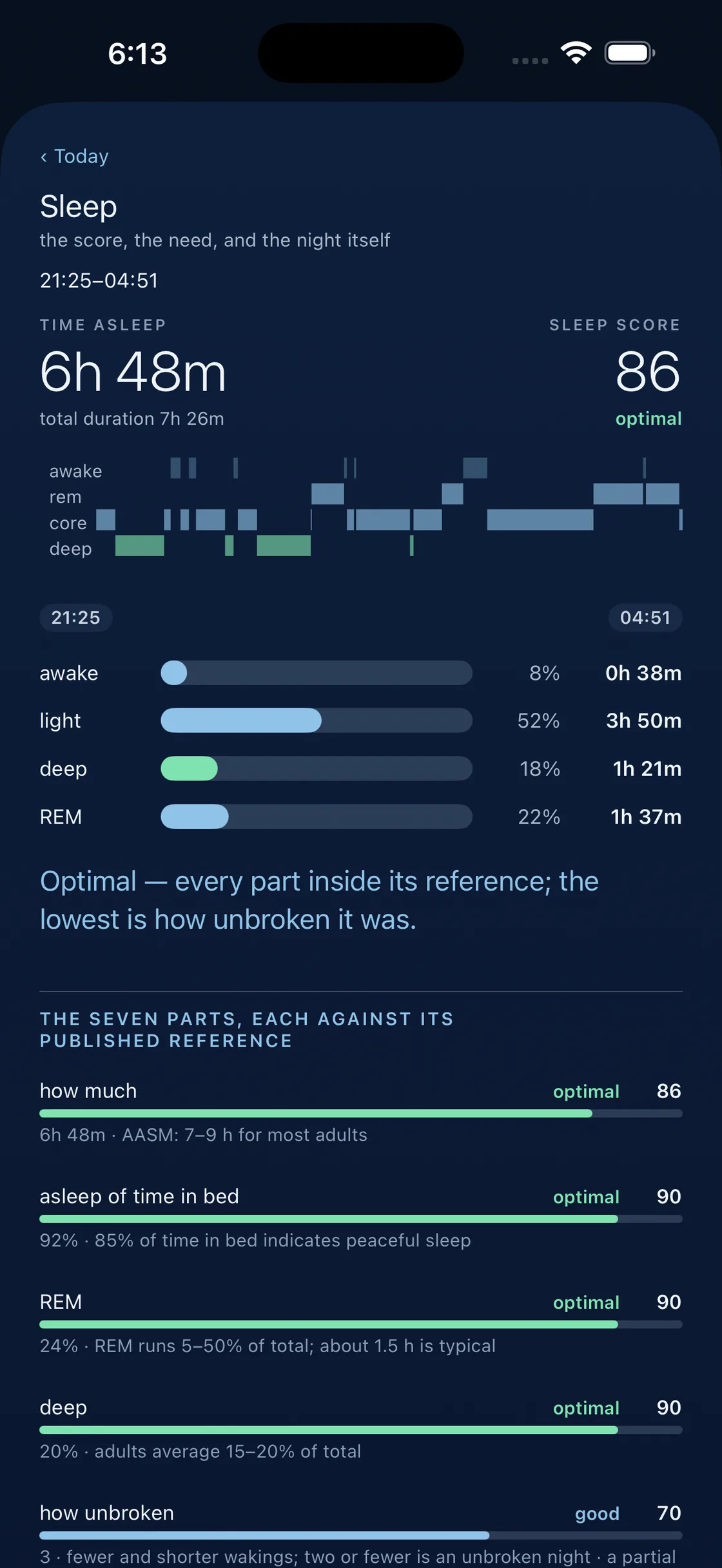
Not inferred, not typical, not plausible. The tempting failure in health software is to fill a gap with something reasonable — an average, a smoothed line, a value carried forward. Each of those claims a measurement that never happened.
A gap in a chart is drawn as a gap.
An absence is verified before it is stated
Saying “nothing here” is a claim too, and it can be wrong the same way a number can. A confident emptiness that turns out to be a bug is worse than a blank space, because it reads as information.
No cause we did not measure
A record knows a reading is absent. It cannot know why. Software that narrates causes it never observed is writing fiction in the register of fact.
No advice the record has not earned
Not “sleep earlier”, not “aim for eight hours” — those are somebody else’s numbers. Where our software suggests anything, it names a lever measured in that person’s own record and carries its evidence in plain words. A suggestion that quotes only its upside is an advertisement.
Statistics decide what is reportable. A person decides what is advisable.
A population is not a person
Where a published study is quoted, it is labelled as what large groups showed over many years — kept visibly apart from anything measured on the reader. Blurring the two makes the strongest claim available while appearing to make the weakest.